Give your orchestral bassists a path into jazz.
A guided introduction to thirds, chords and scales, with keyboard practice and teacher-reviewed pass-offs. Help students build their harmonic foundation, even if jazz bass isn't your specialty.
Students practice on the onscreen keyboard and play pass-offs on a real piano or keyboard.
Request teacher access opens an email to denisse@jazzbass.app asking for a teacher account.
Already in a class? Student sign in
Why a piano? It shows every note of a chord at once, so students see and hear what's inside it, then bring that back to the bass. No piano experience needed. More on why piano
A bassist wants to join jazz band next year.
They can read their orchestra parts, but following chord symbols brings a new set of questions. This course gives you a sequence to guide their practice and a clear way to check their progress.
 What teachers see
Learn the notes, not just the shape.
On bass, a student can slide one fingering to any root and play a B♭7 arpeggio without ever thinking B♭–D–F–A♭. At the piano, F7, B♭7, E♭7 and A7 each use a different mix of white and black keys. There's no single shape to lean on, so students learn what's inside each chord.
That's what they'll need when a chord symbol goes by on a lead sheet. The piano is a learning tool, not a second instrument: everything is in bass clef, and the app shows which keys match the written notes until students can find them on their own.
Students learn and practice. You verify their progress.
Every harmony level works the same way, from Major 3rds to dominant 7ths.
Learn the notes
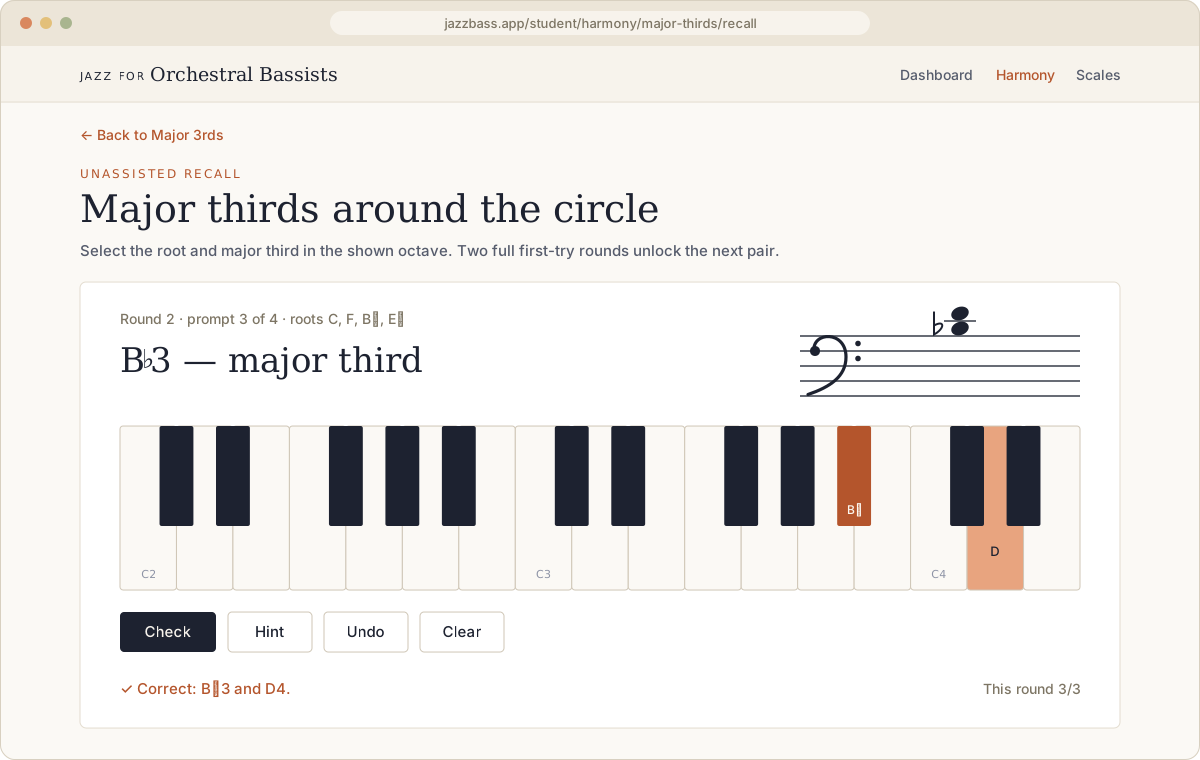
Two new musical keys at a time, in bass clef. The onscreen piano plays each chord and shows where its notes are, until students can find them on their own.
Practice around the circle
Every chord type follows the same path, the Circle of Fourths through all 12 keys, the way jazz harmony often moves (think ii–V–I). Each review covers every key learned so far.
Show it at the keyboard
Students play the whole circle on a real keyboard, record a video and submit it. You review it, and a pass unlocks the next chord type.
Know the notes well enough to keep moving.
You learned your times tables so you wouldn't have to work out 7 × 8. Chords work the same way: a bassist shouldn't have to calculate the notes in the middle of a tune.
For each harmony level, students work toward playing the complete Circle of Fourths correctly on a real keyboard in 12 seconds or less. The online drills show them when they know the material, and they log practice times as they work toward the goal.
- Knowledge
- Mastered ✓
- Personal best
- 13.4 sec
- Pass-off goal
- ≤ 12.0 sec
- Status
- Getting close
Two tracks, side by side.
Harmony and scales run in parallel from the first week. Each harmony level unlocks after a teacher-reviewed pass-off; scales move at the student's own pace.
Ways to apply this knowledge after the course. They aren't lessons in it.
See where every bassist is.
The curriculum carries the sequence. Enroll students, see which harmony and scales unit each one is on, check recall accuracy, and review pass-off videos — approve, or ask for another attempt. It works for one curious bassist or a whole section.
Already have an account? Teacher sign in
What getting started takes.
Students join through their teacher. There's no student sign-up: a teacher adds each student to a class.
- Request teacher access opens an email to denisse@jazzbass.app asking for a teacher account.
- Once your teacher account is ready, sign in with Google, create a class and add students using the Google email addresses they'll sign in with.
- Track progress and review pass-off videos from your dashboard.
Already have an account? Teacher sign in
- A Google account your teacher has added to a class
- A web browser. Practice uses the onscreen piano, with sound.
- A real piano or keyboard, and a phone or camera to record pass-off videos
Already in a class? Student sign in
Start with two notes.
C–E, then F–A. The rest of the circle follows, one key at a time.
Already have an account? Teacher sign in · Student sign in